Immune Signaling Research
Studied in laboratory models examining immune signaling, innate and adaptive immune-response pathways, and immune-cell communication.
Overview
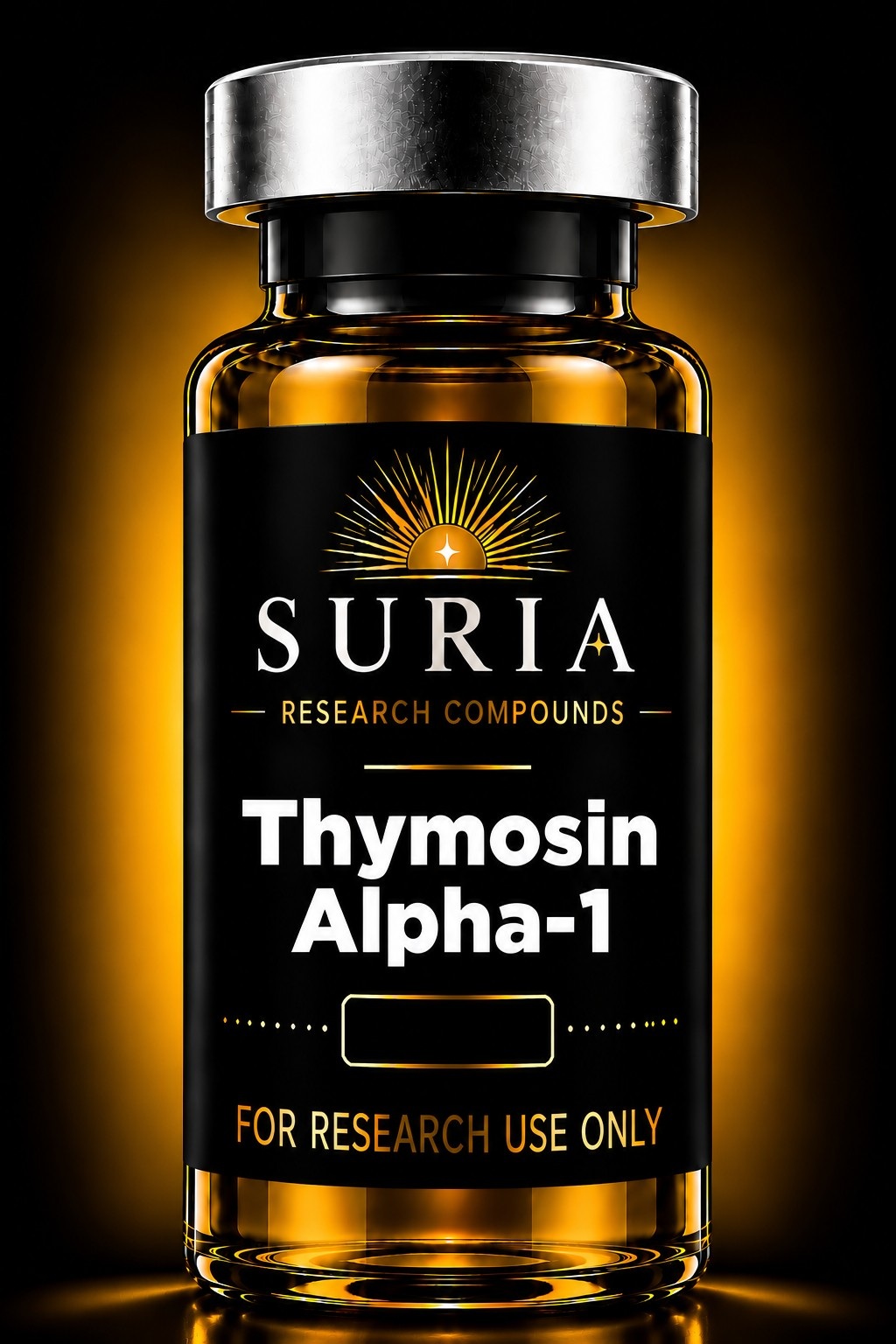
Thymosin Alpha-1 (Tα1, also known in the literature as thymalfasin) is a linear, 28-amino-acid peptide corresponding to the N-terminal region of prothymosin alpha. The molecule is N-terminally acetylated and highly acidic, with a reported molecular mass of approximately 3.1 kDa. Unlike thymosin beta peptides, Tα1 is a distinct molecule with its own sequence and signaling profile.
Published laboratory research has examined Tα1 in models of innate and adaptive immune signaling, including interactions involving Toll-like receptors, dendritic-cell maturation, T-cell biology, cytokine signaling, and downstream pathways such as MyD88, MAPK, IRF, and NF-κB. These pathways make Tα1 useful as a research tool for studying communication between pattern-recognition signaling and cellular immune responses.
Suria's Thymosin Alpha-1 is supplied as a lyophilized research material.
Research Use Only. Not for human or veterinary use.
Specifications
Certificate of Analysis
Certificate of Analysis
Checking certificate…
Other documentation: Batch Documentation.
Research Highlights
Studied in laboratory models examining immune signaling, innate and adaptive immune-response pathways, and immune-cell communication.
A naturally occurring thymic peptide fragment studied for its role in immune-system signaling and cellular-response mechanisms.
Used in experimental systems investigating T-cell-related signaling, cytokine activity, and other cellular immune-response pathways.
A Certificate of Analysis is available for the current inventory; see the Certificate of Analysis section.
Storage
Store at −20°C, protected from light and moisture, until ready for reconstitution.
Store at 2–8°C and use within the laboratory's established handling window.
Avoid repeated freeze-thaw cycles to help preserve peptide integrity across a research protocol.
Research Use Only. Not for human consumption.
Frequently Asked Questions
Batch Documentation
Related Research Compounds